
Where to Place an AED at Work
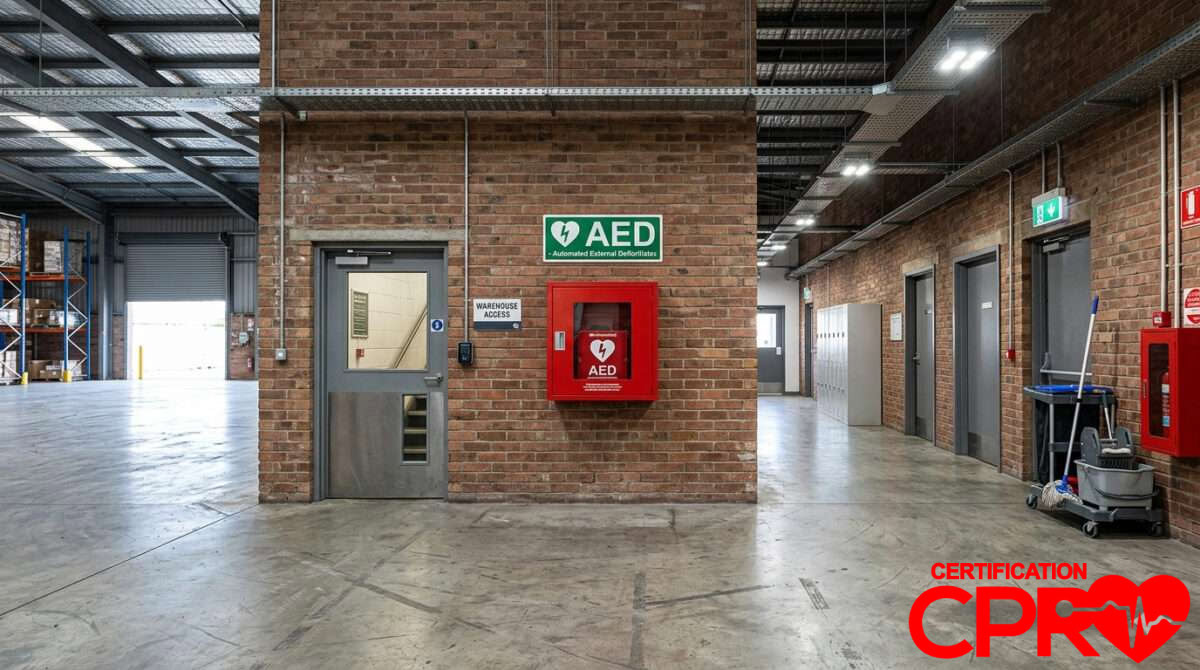
Buying an AED is only part of the preparation. Where you put it determines whether someone can actually reach it in time. Placement decisions shape the entire response, because a device that takes four minutes to retrieve offers much less protection than one that takes ninety seconds. Response time is the number that drives everything else.
The standard most safety guidelines point to is having an AED accessible within three to five minutes of any location where cardiac arrest could occur. That window reflects how quickly the brain begins to suffer irreversible damage without a functioning heart rhythm. For a shockable rhythm, every minute without defibrillation reduces survival by roughly ten percent. The three-to-five-minute target is not arbitrary, it is based on what the data shows about when AED use makes a meaningful difference.
Reaching that target in a real workplace requires thinking about the building, not just the square footage. Layout, floor count, security doors, elevator access, and the locations where people actually spend their time all affect how placement should be planned.
AED placement in Nashville should match where people actually move: near a front desk, security post, gym entrance, school office, airport work area, or the corridor staff use to reach a crowd. A device locked away from the likely emergency path loses precious minutes.
Upcoming CPR Class Dates and Times
The Three-to-Five Minute Rule
The three-to-five minute rule means a responder should be able to get to the AED, retrieve it, and return to the patient within that window. This is not the same as having the AED within a certain number of feet. Walking speed, building layout, stairwells, and locked access points all affect retrieval time in ways that square footage alone does not capture.
A practical way to test placement is to walk from different points in the building to the AED location and time the round trip. If any area of the building cannot reach the device within three to five minutes at a normal walking pace, that area likely needs its own unit or a satellite placement closer to where people work.
Multi-story buildings almost always need one AED per floor. Waiting for someone to travel between floors to retrieve a device adds time that the three-to-five minute window cannot absorb. Stairwell access in an emergency is also less predictable than it sounds on paper. Floor-level placement removes that variable entirely.
High-Traffic and High-Risk Areas
Cardiac arrest does not follow a schedule, but it is more likely to happen where more people spend more time. Placing AEDs near high-traffic areas increases the probability that someone is nearby when an event occurs and that the device can be retrieved without a long search.
Conference rooms, lobbies, break rooms, fitness areas, and main corridors are strong candidates for primary placement. These are locations where employees and visitors concentrate, where physical exertion sometimes happens, and where an event is most likely to be witnessed quickly by someone who can start the response.
Physical exertion areas deserve extra attention. A workplace gym, a loading dock, a warehouse floor, or any space where workers perform strenuous activity presents elevated risk. If your facility includes any of these spaces, placing an AED nearby, not just in the main building corridor, is worth the additional unit cost.
Visibility and Signage
An AED that nobody can find in a moment of stress is not fully functional as a safety resource. The device needs to be visible, marked, and in a location where someone unfamiliar with the building can find it without asking for directions.
Wall-mounted cabinets with overhead signage are the standard approach. The cabinet should be at eye level, not tucked into a corner or placed behind another object that blocks the sightline. Overhead signs that hang from the ceiling or project from the wall help in larger spaces where a wall-mounted sign may not be visible from across the room.
Alarms on the cabinet door serve two purposes: they immediately alert people in the area that an emergency response is starting, and they discourage casual tampering with the device. Some businesses resist alarm-equipped cabinets out of concern about false activations, but the alert function is part of what makes the AED accessible to a bystander who may have never retrieved one before.
Avoiding Poor Placement Choices
Locked rooms, supply closets, nurse’s offices, and similar locations seem like secure options but create access barriers that cost time. If reaching the AED requires finding a key, entering a code, or locating a specific staff member, retrieval time increases significantly, and the person who needs to retrieve it may be the only person available, meaning they have to leave the patient.
Storage areas, loading docks, and maintenance spaces are also poor primary placement locations unless those spaces have their own population of workers. Placing an AED where it is convenient for maintenance staff but far from the people who spend most of their working hours in the building does not serve the response well.
Avoid placing AEDs in extreme temperature environments. Units should be stored within the manufacturer’s specified temperature range. Very hot or very cold storage spaces can degrade battery life and pad adhesive. A cabinet in direct sunlight against an exterior wall in summer, or in an unconditioned mechanical room, may expose the unit to conditions that affect its reliability over time.
Documenting and Communicating Locations
Every person in the building should know where the AEDs are before they need one. Post the locations on building maps near elevators and entrances. Include AED locations in new-employee orientation. Review placement as part of your emergency response planning, and update maps and documentation any time a unit is added or moved.
Some organizations use AED location apps or integrate their AED registry with building emergency systems so that dispatchers can direct callers to the nearest unit. These tools are especially useful in larger facilities where employees may not be familiar with the entire building layout.
Knowing the location matters less if the people who need to act do not know how to use the device. AED placement planning works best when it is paired with onsite CPR and AED training so the people who work near the device understand what to do when the cabinet door opens.
Maintenance and Inspection Requirements
An AED that has not been inspected recently may not be ready to use. Pads expire, batteries discharge, and software updates may be available. Most AEDs have a status indicator light on the device that shows whether the unit is ready. That indicator should be checked on a regular inspection schedule, typically monthly at minimum.
Upcoming CPR Class Dates and Times
Assign someone responsibility for each unit and document every inspection. Replacement pads and batteries should be ordered before the existing ones expire, not after. Many facilities keep one set of backup pads on hand near each unit so that a replacement is immediately available after the device has been used.
After any use or activation, the AED needs to be returned to ready status before it goes back into service. Contact the manufacturer or your maintenance vendor to reset the device, replace used pads, and confirm the unit is operational again.