
What Are the 7 Steps of CPR?
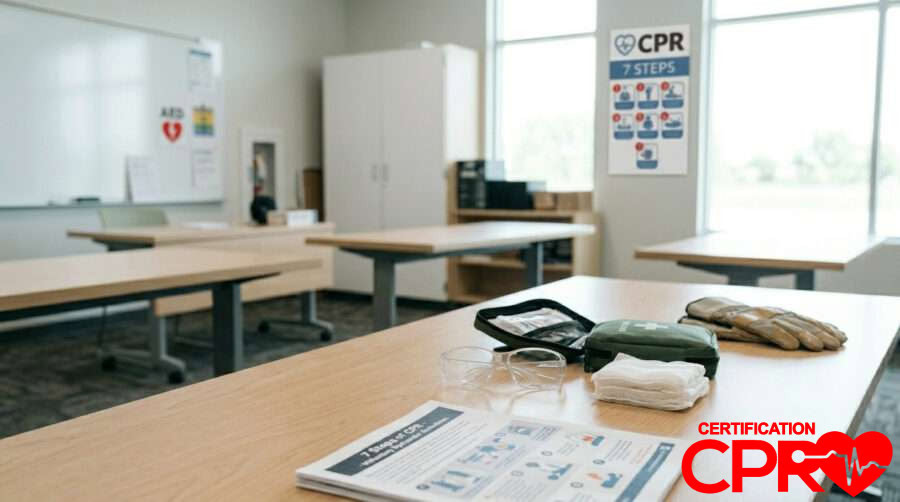
The seven steps of CPR give a chaotic emergency a usable order: check safety, call for help, assess breathing, start compressions, bring in the AED, follow the prompts, and keep going until trained help takes over. The number is less important than the sequence. A bystander who knows the order is less likely to freeze during the first minute, when hesitation costs the most.
Different classes and charts may combine or label the steps a little differently. The response itself stays the same: recognize that the person is unresponsive and not breathing normally, start CPR, use the AED as soon as it arrives, and keep the response going. The list is a memory aid, but the skill comes from practice.
The list is useful because it keeps the decisions in the right order. Hands-on AHA BLS practice is what turns that order into something you can perform under pressure. Reading the steps can help you understand the shape of the emergency. Practicing them gives your body a chance to learn the rhythm.
A sudden collapse in Nashville might be seen first by a teacher, a coworker, a student, a coach, airport staff, or someone working a downtown event. The seven steps matter because the nearest person usually has to recognize the emergency and start the response before a clinician reaches the exact spot.
Upcoming CPR Class Dates and Times
1. Check the Scene and the Person
Make sure the area is safe enough to approach. Traffic, electrical hazards, violence, fire, or chemical exposure can turn one patient into two. Once it is reasonably safe, go to the person and check for responsiveness.
Tap the person’s shoulders and speak loudly enough to get a response. This is the first dividing line in the whole response. An awake, responsive person needs a different kind of help than someone who is completely unresponsive on the ground.
The scene check should be quick, not ceremonial. A responder does not stand back and study every detail. The goal is to notice obvious danger before getting close, then move to the person and find out whether they can respond. If the person answers, moves, or follows a direction, CPR is not the immediate next step. If there is no response, the emergency has moved into a different category.
This first step also helps other people understand that someone has taken charge. In a public place, people may gather, talk over one another, or wait for a more confident person to appear. A clear scene check followed by a direct responsiveness check starts turning the crowd into a response.
2. Call 911 or Send Someone to Call
If the person is unresponsive, call 911 or point to someone specific and direct them to call. In a crowded scene, “someone call 911” is weaker than “you in the blue shirt, call 911 now.”
A direct command works better than hoping the crowd sorts itself out. If an AED is nearby, send someone for that too, because CPR and early defibrillation belong in the same response whenever possible.
The call for help has to happen early because CPR does not replace EMS. The rescuer can start the first response, but the person still needs emergency medical care. If you are alone with a phone, put it on speaker if you can so the dispatcher can stay with you while you start the next steps.
Be specific when assigning jobs. One person calls 911. One person gets the AED. One person opens the door, flags down EMS, or keeps people back. In a workplace, school, gym, or church event, that direct assignment can save time because people know exactly which action belongs to them.
3. Check for Normal Breathing
If the person is not breathing normally or is only gasping, move into CPR. Bystanders often lose time at this point because gasping can look like breathing. It is not enough to keep the response in assessment mode.
Gasping is not normal breathing. It can look like the person is trying to breathe, but it does not mean the situation is stable. If the person is unresponsive and only gasping, treat it like cardiac arrest and move forward.
The breathing check should be brief. Look for normal breathing, not occasional sounds, weak gasps, or movements that make the scene feel less urgent than it is. A person in cardiac arrest may make abnormal gasping motions early in the event. Those gasps can fool bystanders into waiting, and waiting is the mistake this step is meant to prevent.
Once the person is unresponsive and not breathing normally, the response changes from figuring out what happened to acting on what you can do. Call 911 if that has not already happened, start compressions, and bring in the AED as soon as one is available.
4. Start Chest Compressions
Begin compressions once you have confirmed the person is unresponsive and not breathing normally. Place the heel of one hand on the lower half of the breastbone, put your other hand on top, interlace your fingers, and keep your arms straight so your body weight does the work. Push at 100 to 120 compressions per minute, at least 2 inches deep for an adult, and let the chest fully recoil between compressions. This is the part of CPR that turns abstract knowledge into physical skill, which is why hands-on training matters so much.
Good compressions are hard work. People tend to push too lightly, lean on the chest, drift away from the right hand position, or slow down as fatigue sets in. In class, the manikin gives the rescuer a chance to feel the depth, recoil, and pace instead of just reading the numbers.
The priority is steady blood flow. Every long pause interrupts that effort, so the rescuer should keep compressions moving unless the AED is analyzing, a shock is being delivered, EMS takes over, or the scene becomes unsafe. If another trained person is present, switching compressors can help maintain quality when the first rescuer gets tired.
Adult, child, and infant technique differ in important ways, which is another reason the full AHA BLS class matters. The class gives students practice across age groups instead of leaving them to translate an adult-only description during a real emergency.
5. Get an AED if One Is Available
If an AED is nearby, bring it into the response as quickly as possible. You do not wait for CPR to be “finished,” because CPR is not a one-step event. It continues while the AED becomes part of the rescue.
CPR and AED use belong together in cardiac arrest. The sooner the AED gets there, the sooner the rhythm can be checked and the responder can move through the next step instead of pausing.
If more than one person is present, the AED task should be assigned immediately. Public AEDs may be near a lobby, gym desk, pool area, school office, security station, or workplace common area. The person sent for it should bring the whole device back, not just report that one exists.
If you are alone, the decision can depend on where the AED is and whether you can get it quickly without abandoning the person for too long. A class setting is where students can work through those priorities with an instructor instead of trying to solve the timing for the first time during an emergency.
6. Follow the AED Prompts
Turn on the AED, apply the pads to the bare chest, clear the patient when told, and follow the instructions the machine gives. Public AEDs are built for this kind of guided use. You do not need to interpret the rhythm yourself.
The AED handles the rhythm-analysis part that the rescuer cannot do alone. If a shock is advised, stay clear and then get right back to CPR when the device tells you to continue. If no shock is advised, you still keep moving. “No shock advised” is not a stopping point.
The main judgment is clearing the person when the AED tells you to clear. Nobody should be touching the patient during rhythm analysis or shock delivery. The rescuer should say it clearly, look quickly, and make sure hands are off before the device moves forward.
After the analysis or shock, the response returns to CPR unless the person clearly shows signs of life or trained help takes over. The AED is a guide through the cardiac-arrest response, not a finish line. It keeps prompting, and the rescuer keeps following the sequence.
7. Keep Going Until Help Takes Over
Continue CPR and AED-guided care until EMS takes over or the person shows clear signs of life. The final step is staying steady when the response starts to feel repetitive or exhausting.
This last step is where real emergencies test attention. The first minute has shock and urgency. The next few minutes can feel repetitive, tiring, and uncertain. A rescuer may wonder whether the compressions are helping, whether the AED will change its instruction, or whether EMS is close. The safest response is to keep following the sequence.
Upcoming CPR Class Dates and Times
If another trained person is available, switch compressors before fatigue ruins the quality. Keep pauses short. Let the AED guide the rhythm checks. Give EMS a clear handoff when they arrive: what happened, when CPR started, whether the AED advised a shock, and any changes you saw.
A seven-step list is still just a list until you have practiced the compressions, the AED, and the handoffs in class. The list helps you picture the response. Practice makes the response usable when the pressure is high.